
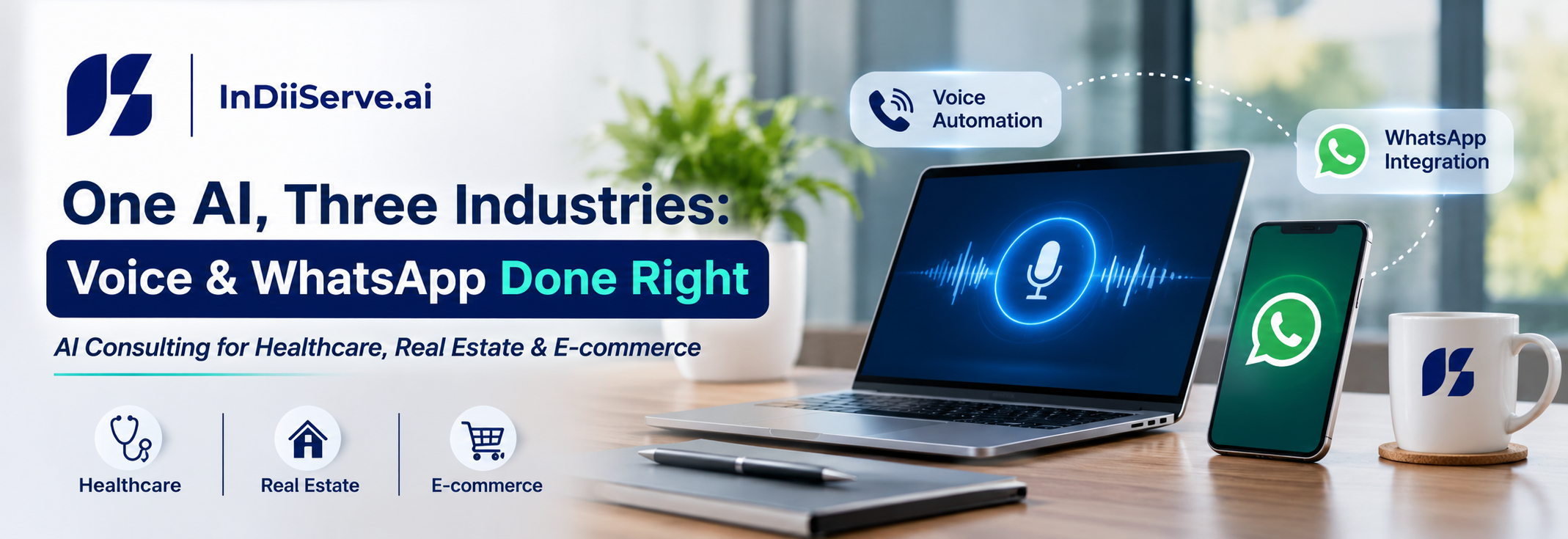
How AI Consulting Services Approach Voice and WhatsApp Automation Across Healthcare, Real Estate and E-commerce
AI consulting services help businesses handle customer calls, messages, and follow-ups automatically.
However, each industry has different needs. Hospitals, real estate agencies, and online stores require different automation solutions to manage customer enquiries and provide better service.
Voice AI agents and WhatsApp automation can help manage these interactions more consistently. The real value comes from designing workflows around what customers actually need, rather than deploying the same chatbot or automated calling system across every business.
Why Voice and WhatsApp Automation Require Different Strategies
Voice automation allows customers to communicate naturally through phone conversations, while WhatsApp automation supports text-based enquiries, notifications, and follow-ups. Both channels can operate together, but they serve different purposes.
For example, someone looking for an immediate appointment may prefer speaking to an automated voice assistant. A customer checking an order status might find a WhatsApp message more convenient.
An effective implementation starts by identifying:
Customer intent: What information are people requesting most frequently?
Interaction complexity: Can the enquiry be resolved automatically, or does it require an employee?
Response urgency: Does the customer need an immediate conversation or a scheduled update?
Business integration: Can the automation access relevant information from existing CRM, booking, inventory, or support systems?
This assessment helps determine which interactions should be automated and where human involvement remains necessary.
How Automation Works Across Three Different Industries
The same technology can produce different operational outcomes depending on how it is configured. Healthcare, real estate, and e-commerce provide useful examples.
In a clinic or hospital, a voice agent can pick up routine calls about appointments, clinic timings, and available services, then guide patients toward the right booking process. Once a slot is fixed, WhatsApp takes over with confirmations, preparation instructions, and gentle reminders. The result is a front desk that spends less time on repetitive calls and more time on patients who are physically in front of them.
Real estate teams work differently, because speed and context decide whether an enquiry becomes a site visit. A voice agent can respond to a prospect straight away, ask about property type, budget, and preferred location, and schedule a visit when the lead looks promising. WhatsApp then keeps the conversation warm by sharing brochures and property details, confirming viewings, and following up with people who have gone quiet.
For online stores, the real work begins after the order is placed. Customers want to know where their parcel is, why a delivery is late, or how to return an item. WhatsApp handles these routine updates and requests easily, while a voice agent is there for shoppers who would rather talk through a problem than type it out. Together, they support the customer from checkout to delivery and beyond.
Healthcare: Supporting Patient Communication
Healthcare providers regularly handle appointment requests, schedule changes, general service enquiries, and patient communication. Managing these interactions manually can put additional pressure on reception and administrative teams.
A voice agent can answer routine questions, collect basic appointment preferences, and direct callers towards the appropriate booking process. WhatsApp automation can then send appointment confirmations and relevant reminders.
However, healthcare automation requires additional care. Systems should avoid providing unverified medical advice or making clinical decisions. Sensitive patient information must be handled through appropriately secured systems, with access controls and applicable privacy requirements.
The objective is to simplify administrative communication without replacing medical professionals or compromising patient trust.
Real Estate: Turning Enquiries into Property Visits
Real estate businesses often receive enquiries from multiple channels, but not every prospect is ready to schedule a property visit.
Voice automation can collect initial information, such as preferred property type, budget range, and location preferences. Based on predefined qualification criteria, suitable enquiries can be routed to sales representatives.
WhatsApp can support the next stage by sharing property information, coordinating viewing appointments, and following up with interested prospects.
An important consideration is lead context. If someone has already explained their requirements during a phone conversation, the sales representative should receive that information before making another call. This avoids repetitive questions and creates a more consistent customer experience.
E-commerce: Managing Conversations After Purchase
For online retailers, customer communication does not end when an order is placed. Buyers may ask about payment confirmation, shipping progress, delivery delays, exchanges, or refunds.
WhatsApp automation can handle routine order-status requests when connected to reliable order information. Voice agents can assist customers who prefer speaking with support teams, particularly when an issue requires additional clarification.
Automation should also recognize exceptions. A delayed delivery, failed payment, or disputed transaction may require human review rather than another automated response.
This distinction helps businesses resolve routine requests efficiently while ensuring more complicated cases receive appropriate attention.
What Businesses Should Evaluate Before Implementing Automation
Selecting a technology platform is only one part of the process. Successful deployment depends on the quality of the underlying workflows.
Businesses should evaluate five practical considerations:
System integration: Connect communication channels with relevant CRM, scheduling, inventory, or support platforms.
Conversation design: Prepare clear responses for common questions and define what the system should do when it cannot understand a request.
Human escalation: Make it easy for customers to reach an employee when their enquiry requires individual attention.
Data protection: Establish consent, access permissions, retention practices, and appropriate safeguards for customer information.
Performance measurement: Track response time, successful bookings, qualified leads, resolution rates, and escalation frequency.
WhatsApp communication also has platform-specific requirements. Businesses should follow the official WhatsApp Business messaging policies, including applicable consent, approved template, and customer-service-window rules.
Rather than automating every conversation immediately, businesses can begin with a high-volume, clearly defined workflow. Testing that workflow with real interactions helps identify gaps before expanding automation across other departments.
Making Automation Useful Beyond the First Interaction
The most effective communication systems do more than answer incoming questions. They preserve conversation history, capture relevant customer information, and connect interactions with the next business action.
For example, a property enquiry should not disappear after an automated conversation. It should become an actionable lead for the sales team. Similarly, an appointment request should connect with the relevant scheduling process, while an e-commerce support conversation should retain the customer's order context.
AI consulting services can help businesses identify these opportunities, design suitable voice and WhatsApp workflows, and align automation with existing operations. The focus should remain on reducing repetitive work while keeping customer communication accurate, accessible, and appropriately supported by human teams.
Businesses exploring voice agents, WhatsApp chatbots, and connected business workflows can explore InDiiServe.ai to understand how tailored automation can support customer communication and operational efficiency.
FAQs
1. What are AI consulting services for voice and WhatsApp automation?
AI consulting services help businesses plan and set up automated calls and messages. The experts study your customer needs and design workflows that fit your business.
2. Can the same automation work for every industry?
No. Each industry has different needs. A clinic, a property agency, and an online store all talk to customers in different ways, so each one needs its own workflow.
3. When should a business use voice AI instead of WhatsApp?
Voice AI works well when a customer wants a quick answer or an urgent appointment. WhatsApp is better for order updates, reminders, brochures, and follow-ups. Many businesses use both together.
4. Is AI safe to use in healthcare communication?
Yes, if it is set up with care. It should handle only administrative tasks like booking and reminders. It should never give medical advice. Patient data must also stay protected with proper access controls.
5. How does automation help real estate businesses?
It responds to enquiries quickly and collects details like budget and location. Good leads then go to the sales team along with the conversation details. This saves time and avoids repeated questions.
6. Can WhatsApp automation handle e-commerce support?
Yes. It can share order status, delivery updates, and return request details. Complex issues like failed payments or disputes should go to a human team member.
7. Will customers still be able to talk to a real person?
They should be. Every good setup includes an easy way to reach an employee when the issue needs personal attention.
8. Do businesses need to follow WhatsApp rules?
Yes. Businesses must follow the official WhatsApp Business messaging policies. This includes customer consent, approved message templates, and customer-service-window rules.
9. How should a business start with automation?
Start small. Pick one high-volume task, such as appointment booking or order tracking. Test it with real customers, fix any gaps, and then expand to other areas.
10. How can InDiiServe.ai help with voice and WhatsApp automation?
InDiiServe.ai helps businesses design customized voice and WhatsApp workflows that connect with their existing systems. The goal is to reduce repetitive work while keeping customer communication clear and supported by humans.
Discussion
0 Thoughts shared