
AI Voice Agent for Business ROI: How Mid-Sized Teams Can Calculate Cost per Resolved Call Before Buying
Most quotes for an AI voice agent for business arrive with a per-minute price, and that number says very little about what a solved customer problem will cost. A call that ends in a transfer still burns minutes. A call that ends in a callback the next morning burns them twice. Honest AI voice agent ROI starts with a different denominator: the calls the agent actually closes.
This guide walks mid-sized teams through the math, with a worked example you can rebuild in a spreadsheet before signing anything.
What cost per resolved call measures
Cost per resolved call is the total monthly cost of running the agent, divided by the number of calls it finishes without a human stepping in and without the customer calling back about the same issue.
Numerator: usage charges + fixed monthly costs + staff time spent finishing calls the agent couldn't close
Denominator: calls the agent resolved on its own
Other common metrics hide something. A per-minute rate ignores failures. Containment, meaning calls that stay with the agent, counts a frustrated caller who hangs up as a success.
The cost lines most quotes leave out
Usage: telephony, speech recognition, the language model and synthesized voice, plus any platform fee.
Build and integration: connecting your phone system, CRM, billing and calendar. Spread this over 12 or 24 months.
Tuning: someone has to review recordings, fix wrong answers and update scripts when policies change.
Storage and compliance: call recordings, transcripts and consent prompts.
Failed-call cleanup: staff time spent on transfers and repeat contacts.
The last line is the one budgets miss most often, and it moves the result more than any other.
A worked example (illustrative numbers)
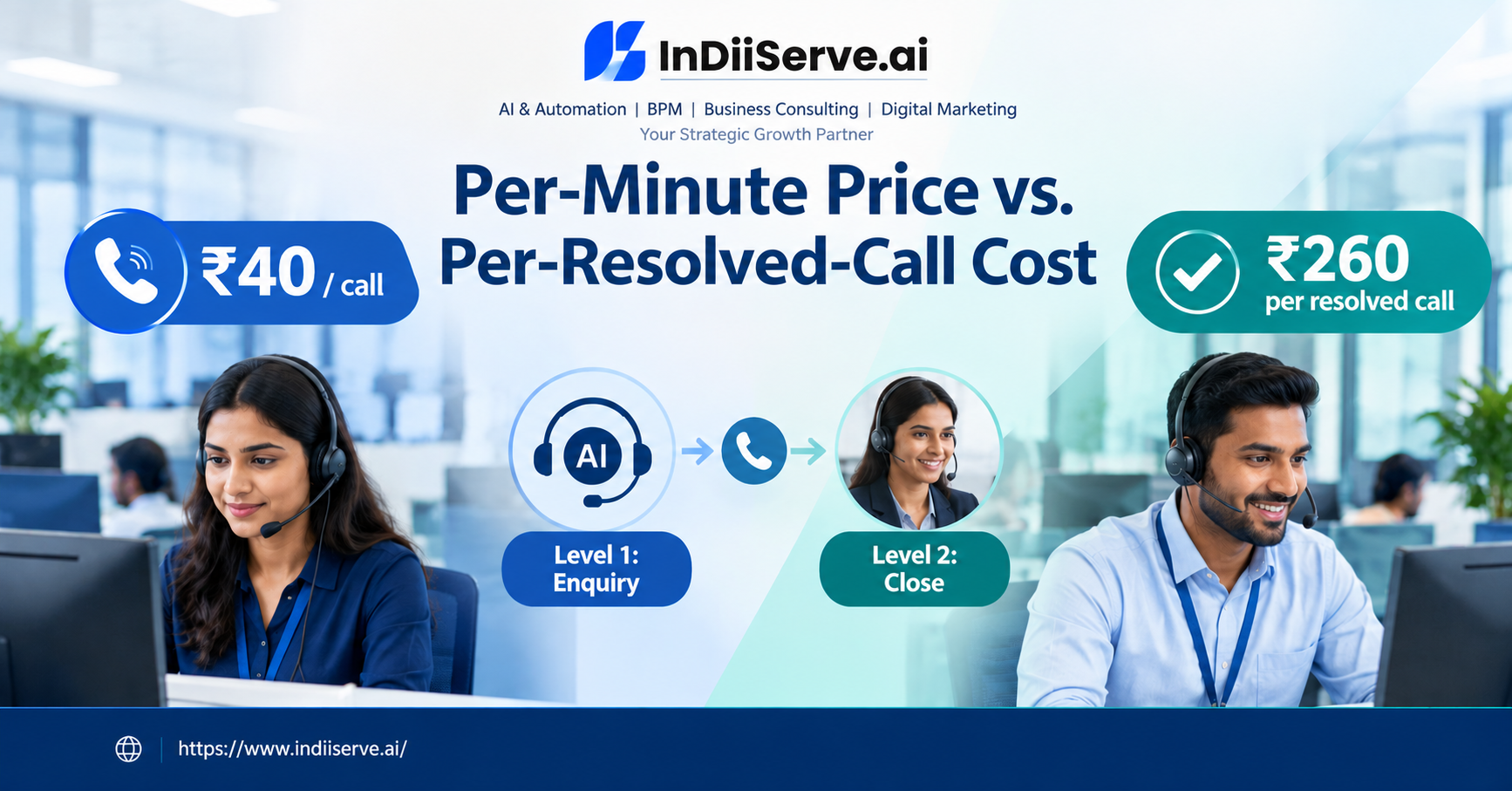
Say a team routes 10,000 enquiry calls a month to an AI agent. The AI works at Level 1, the enquiry stage, handling questions, status checks and basic details. Anything it can't close goes to a Level 2 human agent, who completes the call. Replace every figure below with your own.
Usage (Level 1, AI): at ₹40 per call, this comes to ₹4,00,000 a month.
Fixed costs: the build spread over 12 months, plus QA and tuning, adds ₹2,00,000 a month.
Level 2 escalations: 4,000 calls need a human agent, made up of 3,000 transfers and 1,000 repeat enquiries. At ₹240 each, that's ₹9,60,000 a month.
Total monthly cost: ₹15,60,000.
The AI closed 6,000 of the 10,000 calls at Level 1. That makes the cost per resolved call ₹15,60,000 ÷ 6,000 = ₹260.
A usage-only view would have shown ₹40 per call and an enormous saving. The real figure is more than six times higher. Now compare it with what your team spends per resolved call today, using finance data that includes salaries, benefits, supervision, QA and software. At ₹360 in-house, the AI saves ₹100 per call. At ₹240, it loses money.
Then test the resolution rate. Lift it from 60% to 75% and 7,500 calls resolve at Level 1 while 2,500 go to Level 2. The total drops to ₹12,00,000, and the cost per resolved call falls to ₹160. The Level 1 resolution rate usually matters more than the per-minute price. Keep in mind that none of this is about replacing your human agents. The AI absorbs the repetitive first-stage enquiries, which frees your Level 2 team to spend their time on the conversations that actually need a person, and that is how the business takes on more calls and grows without its costs rising at the same pace.
What lifts the resolution rate
Resolution depends less on the voice than on what sits behind it. When you scope an AI voice agent for business around one high-volume call type, such as appointment changes or order status, you can test the numbers quickly and avoid paying for edge cases you haven't seen yet. The agent also needs access to your systems. If it can only read data, it can only promise follow-up, and that's how transfers and repeat calls creep in. Mapping call flows through a business process management review first, then connecting them with AI automation for scheduling, payments or order updates, gives the agent something to complete rather than just discuss. It also helps to see the wider range of technology services a voice project touches, such as CRM links and call analytics, so none of them surprise you in the budget.
Sector matters too. Teams in the information technology space often field repetitive tier-one calls like password resets, ticket status and access requests, and those suit an agent because the answers live in structured systems. Whatever your sector, compare quotes on equal footing. Ask each provider to split its price into build, usage and ongoing support, and check how its pricing packages are structured: fixed monthly, per-minute or tied to outcomes.
Questions to ask before you sign
How is a "resolved" call defined, and who verifies it?
What happens to our cost if resolution falls ten points below the forecast?
Does the agent write back to our systems, or only read from them?
Who owns the tuning after launch, and is it billed separately?
When a call goes to staff, does the person receive a summary of what was said?
Any AI voice agent ROI that can't answer these is a usage estimate, not a business case.
Run it on your own call logs
Pick one call type, count a month of volume, price the cost lines above and test three resolution rates: pessimistic, expected and optimistic. If the AI voice agent for business still beats your current cost per resolved call at the pessimistic rate, the case is sturdy. If it only works at the optimistic one, narrow the scope or wait until your systems are ready.
If you'd like a second pair of eyes on those numbers, the team at InDiiServe AI can walk through your call types, systems and handoff rules. Its voice agent work begins with a discovery step that maps where automation fits before any conversation flows are designed.
FAQs
What is the cost per resolved call?
It's your total monthly cost of running the AI agent, divided by the number of calls it closes at Level 1 without a transfer or a repeat enquiry. In the example above, ₹15,60,000 ÷ 6,000 calls = ₹260.
Why isn't the per-minute price enough to judge ROI?
A per-minute price only covers usage. It ignores build costs, tuning, and the Level 2 agent time spent on calls the AI couldn't close, which is often the biggest cost line.
Does an AI voice agent replace human agents?
No. The AI handles repetitive Level 1 enquiries, such as status checks and basic questions. Human agents at Level 2 close the calls that need judgment, so the team can handle more volume without growing at the same pace.
What counts as a "resolved" call?
A call the AI closes at Level 1 with no transfer to Level 2 and no repeat contact on the same issue within seven days. Agree on this definition before you start measuring.
What costs do vendors often leave out of quotes?
Integration with your CRM and phone system, ongoing tuning and QA, call recording and storage, and the Level 2 time spent on escalations and repeat enquiries.
How does the resolution rate affect cost?
It matters more than the usage price. In the example, raising Level 1 resolution from 60% to 75% drops the cost per resolved call from ₹260 to ₹160.
How do I know if the numbers work for my team?
Compare your AI figure with your current cost per resolved call, including salaries, supervision, QA and software. Test a pessimistic, an expected and an optimistic resolution rate. If it only works at the optimistic one, narrow the scope first.
Is it worth it at low call volumes?
Often not at first. Fixed costs like the build and tuning take a larger share when volume is small, so start with one high-volume call type and scale once the numbers hold.
Discussion
0 Thoughts shared